When Andrea Norton was a Western High School senior in 1998 contemplating her next steps, she hoped the military would offer education, adventure, and the chance to travel the world.
Her time in the U.S. Air Force didn’t disappoint. She visited several countries and learned new skills. What surprised her, though, was the benefits didn’t stop in 2007 when she left active service.
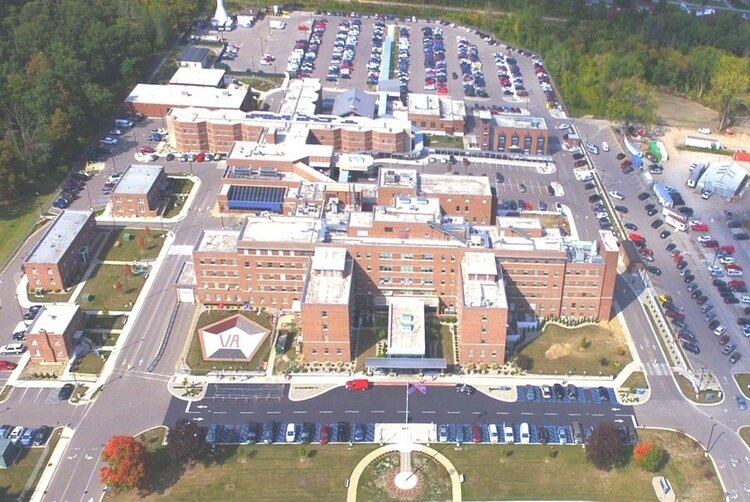
In November 2020, as we celebrate Veterans Day, the military continues to offer Norton opportunities. Norton, who is a Licensed Master Social Worker (LMSW), works as the Women Veterans Program Manager at the Aleda E. Lutz Veterans Affairs Medical Center in Saginaw. As part of her job, she advocates for the VA to provide the medical services women want and need. She also feels personally called to advocate for the LGBTQ community.
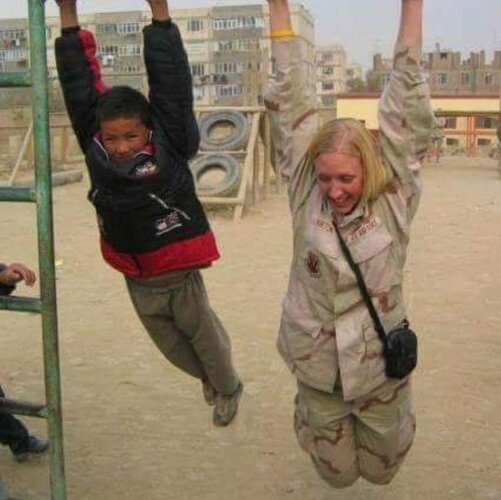 While on active duty with the U.S. Air Force, Andrea Norton visited an Afghanistan orphanage every week to deliver supplies and play with the children.Finally, as a veteran herself and a VA patient, she strongly encourages veterans to consider the VA for medical needs. She believes many veterans don’t realize how VA medical services have changed over the years.
“I always joke and say it’s not your father’s VA because I guarantee he wasn’t able to do a yoga class or acupuncture or health care coaching,” she says. “Those are the things that are integrative services that people don’t think about the VA providing.”
The military gave Norton more than health care options. She is one of a growing number of female military veterans. Women have been part of the military for generations, but the number of women serving jumped significantly during the Gulf War. During Operations Desert Shield and Desert Storm in 1990 and 1991, women were deployed in record numbers. The Military Women’s Memorial estimates that more than 400,000 women were deployed to serve in almost every military unit.
Men and women join the military for a myriad of reasons. For Norton, the journey began when she watched the nightly news with her mom, Joan Norton.
“I grew up with a sense that there was a world bigger than what I was surrounded by,” she says. “I like to do my own thing and forge my own path. I saw this as an opportunity to do that, where I could learn new skills and travel and just do something very different from what anyone would have expected me to do.”
It took a little bit to convince Mom it was the right decision.
Norton’s grandfathers served in World War II. Her paternal grandfather, Clyde Norton, was in the U.S. Marine Corps. Her maternal grandfather, Harold Klass, was in the U.S. Navy. Her father, Larry Norton, served in the Navy during Vietnam, but her mom still had doubts about sending her daughter off to serve.
Her mom turned to Norton’s great uncle, Joseph Kata, who worked full-time with the Michigan National Guard until retiring in 1992 as a Chief Warrant Officer 3. His advice was to not fight the decision.
“He told her to have me talk to every recruiter and hear what they all have to say and then make a decision. You can help her make the right decision,” Kata told Norton’s mom.
Today, Norton offers that same advice to young people interested in the military.
As a young woman, she liked what the Air Force recruiter had to say and signed up, expecting to work on an air crew. Instead, she was sent to work in the intelligence field. She learned to read satellite imagery so well she can tell you exactly what kind of aircraft are sitting on the runway. She honed her skills enough to earn the right to travel as a mobile instructor, teaching others how to accurately read satellite images.