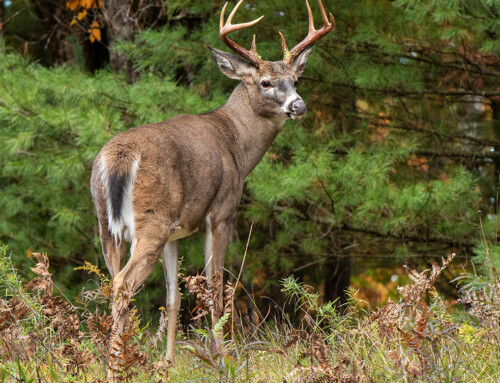

A trail-camera survey – put simply – is the most powerful herd monitoring tool you can use that doesn’t require the assistance of a professional wildlife biologist. On your own, you can estimate deer density, sex ratio, buck age structure, fawn recruitment and more – tons of information that will guide you in achieving Quality Deer Management success where you hunt.
A trail-camera survey involves operating one camera per 100 acres over evenly spaced, baited sites for 14 days. The accuracy of your results depends on how well you run the survey. I compiled the following step-by-step guide for use in Quality Whitetails magazine based on the original research conducted in 1997 by Drs. Harry Jacobson and James Kroll, and I fine-tuned the guide with input from other wildlife biologists who conduct surveys. Even with this guide, you will still have a lot of questions as you work your way through your first trail-camera survey. To answer those questions, QDMA published a book, Deer Cameras: The Science of Scouting, which includes four chapters devoted to helping the reader run successful trail-camera surveys. If you are serious about improving the local deer population through QDM, we strongly encourage you to incorporate trail-camera surveys into your herd monitoring plan.
Of course, some hunters are prevented from conducting baited trail-camera surveys because local or state regulations prohibit the use of bait, such as corn. QDMA’s book goes into detail on different approaches these hunters can use to monitor their local deer population.
Now, for the step-by-step guide.
• Conduct trail-camera surveys in pre-season (after antlers are completely grown but before acorns begin to fall) or post-season (start as soon as hunting season ends but before antler casting begins).
• Avoid timing a survey when natural food sources, such as a heavy acorn crop, will compete with your bait. In general, shelled corn is the best bait to use.
• If you hunt in an area with a traditionally late rut peak (late December into January), wait until October for pre-season surveys so that fawns are old enough to be mobile and appear in survey photos.