If you’re into foraging, this time of year can be downright painful—waiting for temperatures to rise and morels to pop can make for some of the longest weeks of the year.
As winter finally relaxes its grip, you begin cruising Facebook groups and foraging forums. After months of radio silence, sometime around the middle of March, the posts start: “six in Montgomery County,” “two dozen in Adams,” “30 in NE Virginia.” And then, as if they crept into your head and picked the honey hole of your dreams, someone posts a picture of a kitchen table covered in morels: “280, Claire County.”
It’s officially on, but you notice something: For the most part, the pictures all seem to feature the black morel.
The black morel can be a mysterious thing, and it often acts like a different mushroom entirely. Among its unique characteristics, there’s one that often piques a forager’s interest above all others—this species tends to pop first.
Want to find some for yourself? We got in touch with mushroom expert Adam Haritan of the Learn Your Land YouTube series to learn more about when and where to find black morel mushrooms.
What is a Black Morel?
Morels can be broken down into three clades: yellow morels, black morels, and white morels.
While the white morel clade consists of only two species, (Morchella rufobrunnea and Morchella anatolica), both the black and yellow clades account for the rest of the 60-plus species of morels that exist worldwide. Around a dozen of those species are endemic to North America. In short, the term “black morel” describes several species within a clade of mushrooms in the Morchella family.
Black Morel Range
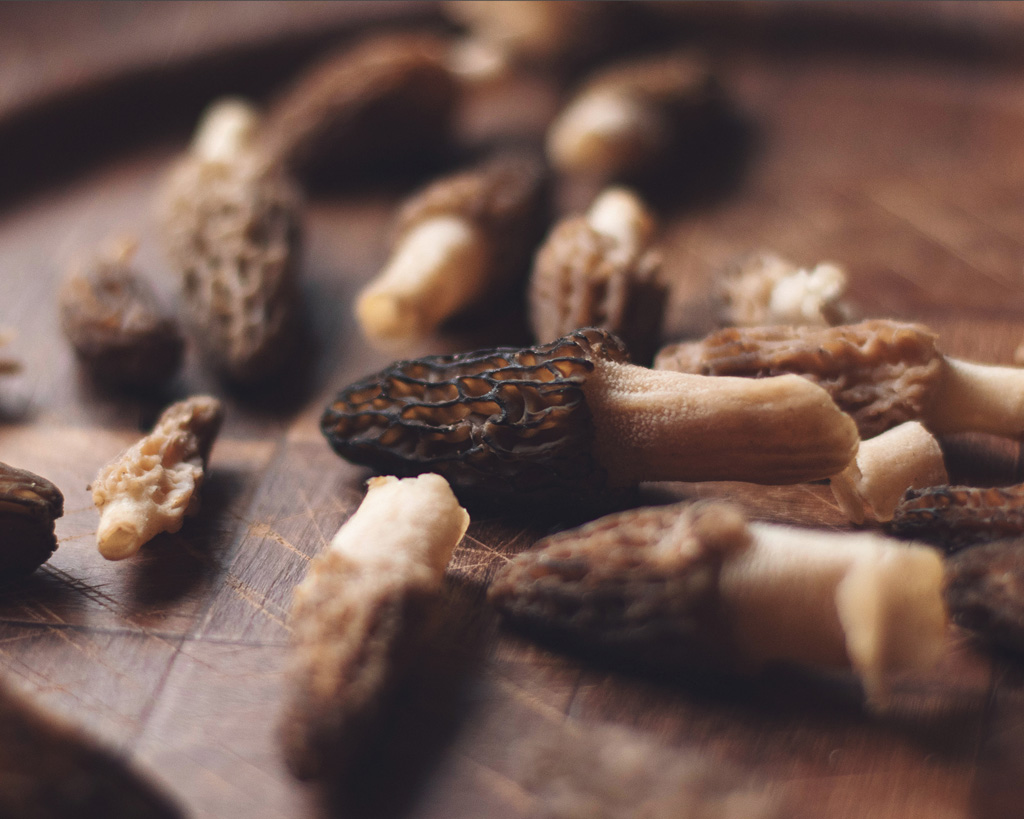
Black morels share many of the same traits as their yellow and white counterparts: they have a honeycomb-like structure defined by a series of parallel pits and ridges. They are entirely hollow with a conical cap that attaches completely to the stem. The easiest way to see both of these traits is by slicing the mushroom in half lengthwise.
Black morels differ from other morels in their coloration. Typically, black morels are anywhere from light brown to near black in color. You’ll find particularly dark specimens in and around burn sites.
Varieties of Morcella, both black and yellow, are widespread across the U.S., occurring in all states (although morels in general are rare in Florida).
When to Find Black Morel Mushrooms
The major allure of the black morel is the fact it’s the first type of morel to flush.
“Timing is an incredibly crucial factor,” Haritan said. “Black morels typically appear before any other type of morel. I have found them as early as the last week of March.”
Of course, this can be a bit of a double-edged sword. “Many people do not find black morels because they’re not looking early enough. By the time they head out to the woods, yellow morels have already started to appear.”
Bottom line: get out and look early.
Where to Find Black Morel Mushrooms
Although folks certainly find morels in varying environments—the mushrooms often seem to grow without rhyme or reason—typically you can hedge your bets by focusing on areas with loamy, fertile soil. Look for a substrate that’s dark brown to black, allows water to drain, and has a little give to it. This is a point Haritan stresses.
“Rarely have I found any morel on ridges with dry soil and low fertility,” he said. “In these latter habitats, you’ll typically find oak, chestnut saplings, and perhaps black birch—trees which are almost never associated with morels, at least in Western Pennsylvania.”
That leads us to what might be the single most important element of a successful black morel hunt—finding the trees with which black morels most often associate. While most foragers on the hunt for yellow morels keep an eye out for dead elms, when targeting black morels, Haritan suggests looking elsewhere.
“Habitats with tulip poplar trees seem to be really good places to look,” he said. “Areas with ash trees can also be productive. Sometimes you’ll find the motherlode under black cherry trees.”