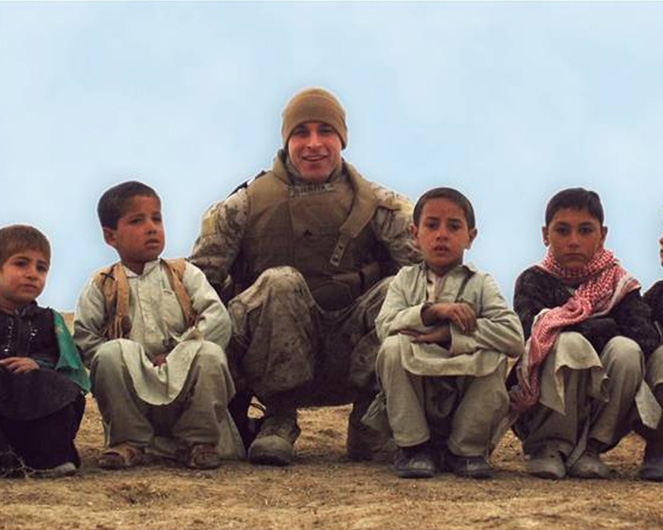
Kate Mannion spent college drinking and playing rugby, so when she joined the Marine Corps in 2008 she did so to become a better person.
She trained as a military police officer and was soon on deck for deployment. At that time the Corps needed female Marines to engage Afghan women. She still had a healthy dose of young, adrenaline-fueled ideas about life in a combat zone and “killing terrorists.”
As a young lance corporal she went into the deployment with pessimistic views about the people, the culture, what she would encounter, how she would be treated as a woman, an American, a Marine.
But her experiences there “ended up flipping me on my head,” she said.
As thousands fled Afghanistan last month, virtuous human moments arose — Marines lifting a child over barbed wire, a baby birthed on an evacuation flight, scattered networks of U.S. veterans scrambling to help their Afghan comrades reach safety.
But amid the chaos, death and destruction that rolled across the country, taking U.S. troops with it, questions emerged, “What went wrong?” “Who’s to blame?” “Was it worth it?” “What’s to come?”
The staggering cost of the 20-year war in Afghanistan, which took an estimated 171,000-174,000 lives and $2.3 trillion, according to a recent report from the Costs of War project at Brown University, hovers darkly over these questions. The war directly resulted in the deaths of 2,442 U.S. service members, according to the study, and the Defense Department reports that more than 20,000 were wounded, many of them catastrophically.
Military Times spoke with Afghanistan veterans about how they struggle to balance the scales of what was given and what was lost, to find what was gained. What will they choose to remember and how will they reconcile those memories as the years pass?
For some, their thoughts flit between worthwhile and futile. Some know they tried to help but see their good intentions as doomed all along. Others know they made a difference and their work will manifest itself in an Afghanistan that is one day free.