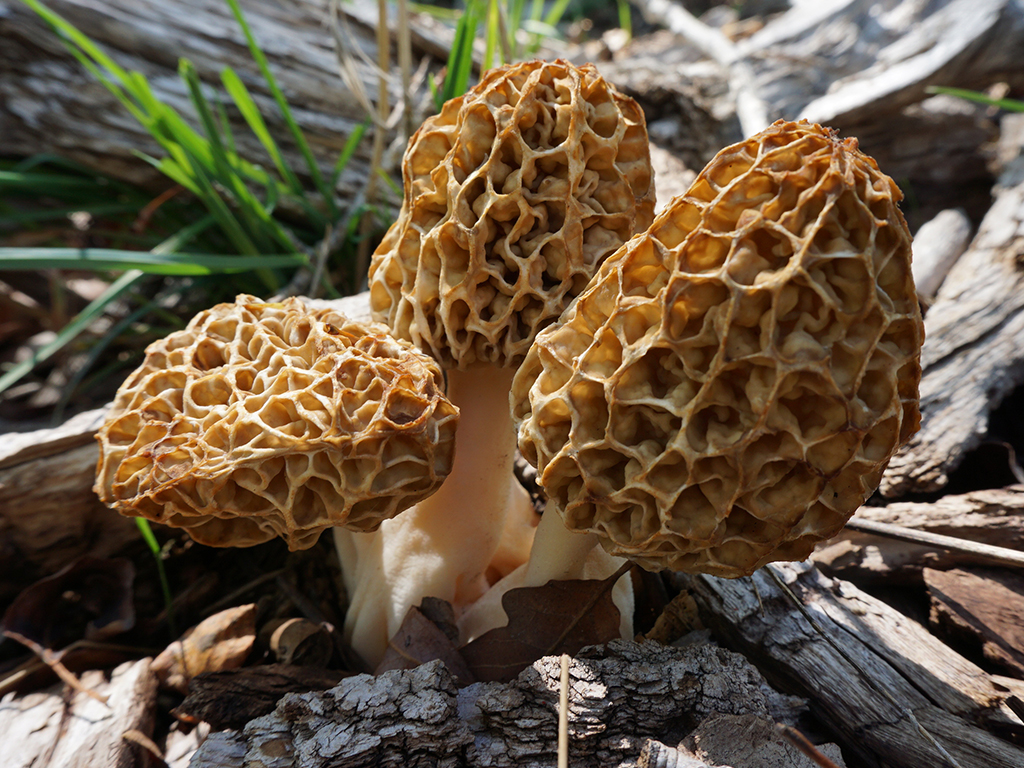
Morel mushrooms are a mystery, a miracle, and a gift of the spring woods. Their arrival of mushroom hunting season often coincides with turkey season. Wild mushrooms can appear overnight and remain maddeningly elusive. Veteran morel mushroom hunters covet their secret spots with a possessive fervor equal to that of any bass fishermen or deer hunter.
Why are wild mushrooms more common in spring?
Morel mushrooms remain a mystery to researchers and foragers alike. Where and why they grow is often the subject of woods-lore. But one thing is certain, there are conditions that cause morels to flush in the spring more than any other time of year. Once you know what to look for in your environment, you’ll be racing to find the next hotspot.
Disturbed ground, clear cuts and wildfire burns all tend to precede a boom in morel growth. So it’s important to know how morels and other mushrooms relate to their environment.
“One of the hypotheses is that the disturbance disrupts the connection between the fungus and the roots of the host trees that are feeding the fungus sugars and carbohydrates,” says Andrew Larson, a forest ecology professor for the University of Montana.
Lastly, when you’re in the woods, try to find a place where morels are already growing. That’s right, morels lead to more morels. It sounds pretty obvious, but think back to what’s going on under the surface. Morels are part of a larger more expansive fungus that’s probably all around you, right under the soil.
“Any mushroom hunter can tell you this. If you find one, you need to freeze and look around. You’re much more likely to find more within 20 feet,” Larson says.
Timing is everything. Start with the leaves
“The old timers say that when the oak leaves are the size of a mouse’s ear then that’s the time to look for morels,” says Rick Hill, a wildlife artist and dedicated mushroom hunter. “And that’s usually about right.”
Know your trees to find morel mushrooms
Morels are often found near trees, but not just any tree, explains Joe Lacefield. He is a wildlife biologist who primarily works with private landowners. Lacefield knows mushrooms. If you want to find morels, he says start by learning to identify trees: sycamore, hickory, ash, and elm are four to focus on first. Morels favor fruit trees, too. “An old apple orchard is often a productive area,” he says. Here are some tips for identifying them.